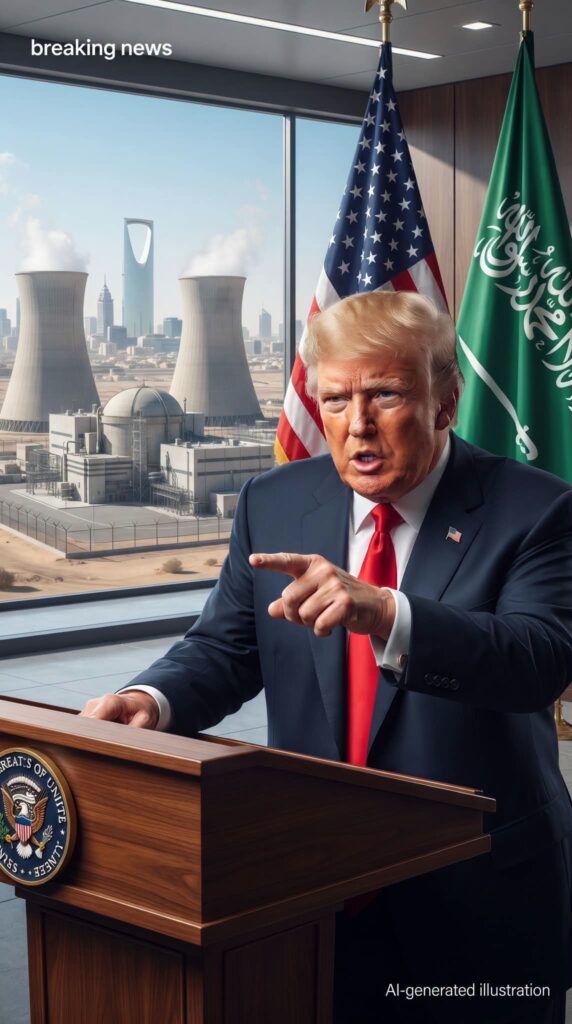
Washington / Riyadh -UNS:In one of the most significant developments in U.S.–Saudi relations in recent years, the United States and Saudi Arabia have signed a landmark civil nuclear cooperation agreement, establishing the legal framework for long-term collaboration on the Kingdom’s peaceful nuclear energy program.
The agreement, signed in Washington by U.S. Secretary of Energy Chris Wright and Saudi Minister of Energy Prince Abdulaziz bin Salman, is widely viewed as a major strategic milestone that will deepen bilateral cooperation in energy, advanced technology, and regional security while creating billions of dollars in future investment opportunities.
The “123 Agreement”
According to the U.S. Department of Energy, the accord is a Section 123 Agreement, named after Section 123 of the U.S. Atomic Energy Act. Such agreements are a legal prerequisite for the United States to engage in civilian nuclear cooperation with foreign partners, allowing the transfer of nuclear technology, equipment, materials, and services exclusively for peaceful purposes under strict non-proliferation safeguards.
Alongside the 123 Agreement, both governments also signed a bilateral Nuclear Safeguards Agreement, reinforcing commitments to nuclear security, safety, and international non-proliferation standards.
The Department of Energy said the agreements establish a multi-decade strategic partnership valued at billions of dollars, providing American companies with significant opportunities to participate in the development of Saudi Arabia’s civilian nuclear energy program.
U.S. Perspective
The U.S. Department of Energy described the agreements as a major step toward strengthening peaceful nuclear cooperation between Washington and Riyadh.
The department emphasized that the framework will:
Expand U.S. participation in Saudi Arabia’s civil nuclear program.
Support American manufacturing and nuclear supply chains.
Increase exports of U.S. nuclear technology.
Create high-paying jobs in the United States.
Strengthen U.S. energy and national security.
Promote global nuclear non-proliferation standards.
Enhance long-term strategic ties between the United States and Saudi Arabia.
Secretary of Energy Chris Wright said the agreements reflect both countries’ commitment to expanding their commercial and strategic partnership while adhering to the highest international standards of nuclear safety, security, and non-proliferation.
Saudi Perspective
Saudi Arabia’s official news agency (SPA) stated that the agreement forms part of the broader strategic partnership between the two countries and follows the announcement made during Crown Prince and Prime Minister Mohammed bin Salman’s visit to the United States in November of last year, when negotiations on peaceful nuclear cooperation were declared complete.
According to SPA, the agreement aims to:
Strengthen cooperation in the peaceful uses of nuclear energy.
Promote the exchange of expertise, knowledge, and advanced technologies.
Support Saudi Arabia’s long-term energy diversification strategy.
Develop advanced technologies.
Encourage investment and industrial cooperation.
Advance sustainable development objectives.
Ensure full compliance with international standards on nuclear safety, security, and non-proliferation.
Saudi officials described the accord as a natural extension of the long-standing energy partnership between the Kingdom and the United States.
Congressional Review
Before entering into force, the agreement will be submitted to the U.S. Congress for review in accordance with the procedures established under the Atomic Energy Act.
Unless Congress blocks the agreement within the statutory review period, it will become legally effective and serve as the governing framework for future civil nuclear cooperation between the two countries.
Strategic Analysis
The agreement represents one of the most consequential strategic understandings between Washington and Riyadh in decades.
For Saudi Arabia, the partnership supports the Kingdom’s efforts to diversify its energy mix under Vision 2030, reduce domestic reliance on oil for electricity generation, and establish a modern civilian nuclear industry capable of meeting rising long-term energy demand.
For the United States, the agreement enables American companies to compete for major contracts in one of the world’s largest emerging nuclear markets while reinforcing Washington’s influence over the development of Saudi Arabia’s nuclear program through internationally recognized safeguards.
The agreement also reflects renewed momentum in U.S.–Saudi strategic relations, expanding cooperation beyond traditional oil and security ties into advanced technologies, clean energy, and critical infrastructure.
From a geopolitical perspective, the accord strengthens U.S. engagement in the Gulf’s evolving energy landscape and reinforces international nuclear governance by ensuring that Saudi Arabia’s civilian nuclear development proceeds under robust safety, security, and non-proliferation commitments.
If fully implemented, the partnership is expected to shape bilateral cooperation for decades, making it one of the defining strategic agreements in the modern history of U.S.–Saudi relations.