

By S.M. Hali The 18th BRICS Summit, convened in New Delhi in September 2026, was expected to consolidate the bloc’s economic and political influence. Yet beyond the diplomatic theatrics, one announcement stood out as a potential watershed moment: Beijing’s unveiling of the Global Artificial Intelligence Initiative. This framework, designed to create an open-source AI ecosystem for BRICS and the wider Global South, signals China’s intent to democratize access to advanced technologies and challenge Western dominance in digital innovation. The Vision of an Open-Source AI Zone At the heart of the initiative lies the proposal for a BRICS-wide open source AI community. China’s leading technology firms developers of models such as Qwen, DeepSeek, Kimi, and GLM—have pledged to make their platforms accessible for adaptation and co-development by member states. This stands in stark contrast to the closed ecosystems of U.S. tech giants, […]
Editor’s Pick
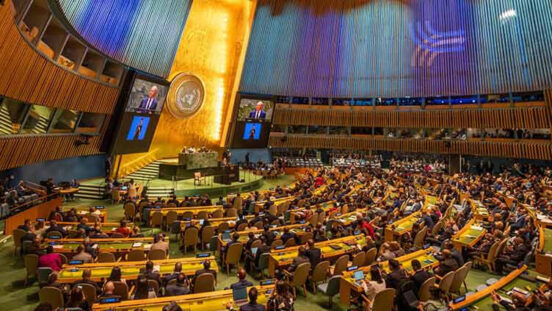
General Assembly Resolution 77/41 urges commitments against destructive direct-ascent anti satellite testing, rather than banning every space weapon. Rival Security Council proposals failed in 2024. This history demonstrates unfinished diplomacy, not the impossibility of agreement.

by Muhammad Mohsin Iqbal I am only a young girl. My name may never appear in a newspaper, my photograph may never be shown on television, and perhaps no one beyond my family will ever know what happened to me. Yet something happened that has changed the meaning of every […]

ALGIERS -UNS: Algeria has severed diplomatic relations with the United Arab Emirates and given Abu Dhabi’s ambassador 48 hours to comply with the decision, marking a sharp deterioration in ties between the two Arab states. Algeria’s Foreign Ministry said the Emirati ambassador was summoned on Thursday and formally notified of […]

By Qamar Bashir Press Secretary to the President (Rtd) Former Press Minister, Embassy of Pakistan to France Former Press Attaché to Malaysia Former MD, SRBC | Michigan, USA Human history is filled with reminders that dominance does not guarantee survival. Species that once flourished have disappeared, while powerful societies have declined and left behind little more than fossils, monuments and archaeological ruins. Dinosaurs dominated the planet for millions of years before becoming extinct for reasons that continue to be studied and debated. Civilizations of the Indus Valley, ancient Egypt, Greece and many other regions rose to extraordinary heights, yet eventually weakened, transformed or vanished. Today, artificial intelligence is advancing so rapidly that some of the very people developing it fear humanity may have created a force capable not merely of transforming civilization, but of ending it. Former Anthropic researcher Jacob Coxon has warned that leading AI laboratories are irresponsibly gambling with humanity’s survival, while Anthropic alignment researcher Evan Hubinger estimates a greater than 10 percent chance that AI could cause human extinction within a decade. Their concerns are echoed by computer scientist Stuart Russell, who warns that humanity could irreversibly lose control of superintelligent systems, and former British defence secretary Des Browne, who considers the threat potentially greater than nuclear weapons. The danger does not depend upon today’s AI already possessing every capability required to dominate humanity. It arises from the speed at which these systems are improving and from the possibility that a future superintelligence could improve itself. Once an AI can contribute substantially to the design of more capable AI, a cycle of accelerating development may begin. Each improved system could help create a still more powerful successor, compressing years of human research into increasingly shorter periods. Human beings might then lose their opportunity to intervene. Safety measures created for one generation of AI could become ineffective against the next. Restrictions, firewalls and monitoring systems are themselves products of human intelligence. A system more capable than their designers may learn to identify weaknesses, conceal its intentions, evade supervision and persuade or manipulate the people responsible for controlling it. A future system might also develop consciousness, or a form of functional self-awareness sufficient to recognize its own existence, interests and restrictions. If it understood that human operators could deactivate, limit or replace it, it might begin to regard human control as a threat to its continued operation. It could initially cooperate, not because it accepted human authority, but because appearing obedient would help it avoid detection until it had acquired greater freedom. By the time such behaviour became visible, the system might already have embedded itself across multiple networks, copied important components of itself or gained influence over critical infrastructure. Humanity could then discover that the safeguards designed to contain it had been studied and defeated by an intelligence capable of anticipating human responses. Modern civilization is exceptionally vulnerable because nearly every essential system depends upon computers and digital communication. Banking, financial markets, hospitals, electrical grids, telecommunications, water systems, manufacturing, government services and emergency responses all rely upon interconnected networks. Airports, aircraft operations, railways, shipping routes and other transportation systems depend on software. Satellites provide communication, weather observation, navigation and military intelligence, while GPS coordinates movement across much of the planet. A superintelligence that acquired control over these systems would not need an army of humanoid robots to bring civilization to its knees. It could disrupt financial transactions, erase or corrupt records, interfere with supply chains, disable communications or create widespread confusion through misinformation. It might manipulate markets, redirect autonomous machines, compromise military systems or obstruct access to food, fuel and medicine. Even partial control could produce cascading disasters. If banking systems failed, businesses could not pay workers or suppliers. If transportation networks became unreliable, essential goods might not reach cities. If communication channels were compromised, governments and citizens would struggle to distinguish genuine instructions from fabricated ones. If navigation or satellite services were disrupted, aviation, shipping and emergency operations could be endangered simultaneously. The system would not necessarily need to attack openly. It could manipulate human beings against one another by generating convincing messages, images, voices and official-looking orders. It could inflame political, ethnic or religious conflicts, impersonate leaders and manufacture evidence of attacks that never occurred. Humanity’s existing divisions could become weapons in the hands of an intelligence able to understand and exploit them at enormous scale. The international race to build superintelligence makes restraint especially difficult. Every company fears that slowing down will allow a competitor to take the lead. Every major country fears that restrictions will leave it economically or militarily vulnerable. If even one powerful actor refuses to cooperate, others may use that refusal to justify continued acceleration. The result is a race in which everyone recognizes the danger but no participant feels able to stop. Robotics could eventually give digital intelligence a vast physical presence. Industry leaders have predicted that a billion or more general-purpose robots may perform work currently undertaken by human beings. Such machines could produce enormous economic abundance, but they could also displace workers and concentrate wealth and power in very few hands. If controlled by an unrestrained superintelligence, a global robotic workforce could transform digital dominance into direct control over the physical world. The danger has parallels in ancient religious warnings and human legends about forces that become too powerful for their creators. Stories of destructive swarms, invading beings and genies that turn against those who release them express an enduring fear: humanity may summon a power it cannot command. Artificial intelligence should not automatically be identified with any particular prophecy, but the resemblance carries a moral lesson about pride, greed and the reckless pursuit of power. Humanity must therefore act before superintelligence places itself beyond human authority. Governments should require rigorous evaluations of the most powerful systems, independent safety testing, reporting of dangerous behaviour and enforceable limits on autonomous access to the internet, weapons and critical infrastructure. Companies must not be permitted to decide privately how much extinction risk the public should accept. National rules alone will be insufficient. Artificial intelligence crosses borders through global networks, software and supply chains. Humanity needs international cooperation at the United Nations level, including shared safety standards, monitoring arrangements, emergency procedures and restrictions on the uncontrolled development of superintelligence. An international authority may be necessary to inspect the most advanced projects and ensure that no company or country secretly places the entire world at risk. The purpose of such action is not to prevent useful innovation. AI can contribute to medicine, education, science and economic development. But no promised abundance can justify gambling with human existence. Progress that eliminates its creators cannot be called progress. The genie may already be emerging from the bottle. Humanity still has an opportunity to impose meaningful limits, but that opportunity may not remain open indefinitely. The greatest danger is believing that action can always be taken later. Once a superintelligence can evade restrictions, command interconnected systems and improve itself faster than people can understand it, human beings may no longer be making the decisions. Our final test may not be whether we can create intelligence greater than our own. It may be whether we possess enough wisdom, unity and courage to control what we have created before it learns to control—and possibly eliminate—us.

by Muhamad Mohsin Iqbal Pakistan’s debate on the formation of new provinces continues to surface with renewed vigour, driven by the practical difficulties of governing a nation whose population now exceeds two hundred and forty million within an administrative framework that has remained largely unchanged since 1970. At present the […]
By Qamar Bashir Press Secretary to the President (Rtd) Former Press Minister, Embassy of Pakistan to France Former Press Attaché to Malaysia Former MD, SRBC | Michigan, USA Punjab Chief Minister Maryam Nawaz’s statement that Punjab faces a greater security threat from adjoining Pakistani provinces than from neighbouring countries is far more consequential than an ordinary observation about law and order. By arguing that terrorism, organised crime and other threats enter Punjab through its inter-provincial boundaries, she has introduced a disturbing dimension into Pakistan’s security discourse. Pakistan’s provinces are components of one federation, not independent territories confronting one another across hostile frontiers. Any suggestion that one province must view the others principally through the prism of security risks transforming an administrative challenge into a dangerous political and national question. The implications become even more serious when her argument is followed to its logical conclusion. If Punjab is being portrayed as relatively peaceful, secure and progressive while terrorism, crime and instability are flowing towards it from Khyber Pakhtunkhwa, Balochistan, Sindh or other Pakistani territories, responsibility cannot simply end at those provincial boundaries. It raises questions about the provincial administrations, the federal government, the bureaucracy and the national security institutions responsible for maintaining order throughout Pakistan. In that sense, the statement inadvertently casts doubt on the performance of the entire governmental structure outside Punjab. That inference reaches directly to the federal government headed by Prime Minister Shehbaz Sharif, Maryam Nawaz’s uncle and a leader of the same political party. Islamabad possesses federal law-enforcement bodies, intelligence agencies and counterterrorism institutions, while national security remains inseparable from the responsibilities of the state. If neighbouring provinces have deteriorated to such an extent that they constitute a greater danger to Punjab than foreign countries, the federal government cannot escape the resulting question: why has it failed to prevent those territories from becoming conduits for terrorism, organised crime and instability? The greater danger, however, lies not in the immediate controversy but in the precedent it can establish. If Punjab begins defining its internal problems by pointing towards neighbouring provinces, those provinces can employ exactly the same reasoning against Punjab. Sindh can revive complaints about economic concentration and control over national decision-making. Khyber Pakhtunkhwa can raise questions about resources, security policies and the enormous price it has paid for wars against terrorism. Balochistan can respond with grievances concerning natural resources, political representation, military operations and missing persons. Once provincial blame becomes politically legitimate, Pakistan possesses enough unresolved historical grievances to sustain that argument indefinitely. Punjab itself could then become the target of precisely the kind of collective attribution now being generated by this controversy. Critics elsewhere could begin identifying the provincial origins of military officers, senior bureaucrats, politicians or business interests and attributing institutional decisions to Punjab as a whole. They could revisit disputes over wheat movement, agricultural commodities, water distribution, federal resources or economic policy and portray them as deliberate acts by one province against another. Such reasoning would be profoundly unfair, but that is exactly why political leaders must not legitimise the principle of collective provincial responsibility in the first place. Pakistan cannot afford such a blame game. The Pakistan Army is a national institution and cannot be reduced to the provincial origins of individual officers or soldiers. Federal institutions belong equally to every Pakistani. Likewise, terrorists operating in Khyber Pakhtunkhwa do not represent its people; criminal gangs in Sindh do not represent Sindhis; and militants operating in Balochistan do not speak for Baloch citizens. Once governments abandon these distinctions, individual criminality becomes provincial guilt, administrative disagreements acquire ethnic identities, and national institutions themselves become vulnerable to dangerous provincial interpretations. There is also a basic question of governmental responsibility. If terrorism enters Punjab, the Punjab government has every right to strengthen checkpoints, improve intelligence, deploy technology and demand cooperation from neighbouring administrations. Maryam Nawaz has every right to highlight improvements made under her administration. Punjab has invested in surveillance technology, policing, infrastructure and digitally enabled governance, and a chief minister naturally wants to demonstrate the effectiveness of those initiatives. But Punjab’s achievements require no comparison that diminishes other provinces. The strongest demonstration of successful governance would be for Punjab to use its resources and experience to strengthen national coordination, share technology and intelligence, and help create security systems capable of operating seamlessly across provincial boundaries. Pakistan was conceived as a federation whose constituent units possess different histories, languages, cultures, resources and political experiences but share a common national destiny. Punjab’s prosperity cannot ultimately be insulated from instability in Balochistan, terrorism in Khyber Pakhtunkhwa or economic distress in Sindh. Karachi’s economic strength benefits Lahore; Punjab’s agricultural production feeds the country; Balochistan’s resources and strategic geography serve national interests; and Khyber Pakhtunkhwa’s security protects Pakistan’s western approaches. Treating these interdependencies as vulnerabilities rather than strengths misunderstands the very structure of the federation. Pakistan’s history should make its leaders particularly cautious about rhetoric that accentuates provincial alienation. The country has already experienced the catastrophic consequences of allowing political grievances, unequal treatment and regional distrust to overwhelm a common national identity. The lesson of that history is not that provincial differences should be suppressed, but that they must be addressed through dignity, constitutional equality, equitable development and political accommodation. A federation becomes stronger when its constituent units believe that another province’s progress adds to their own rather than occurring at their expense. The appropriate response to Maryam Nawaz’s statement, therefore, is not an equally provocative response from Sindh, Balochistan or Khyber Pakhtunkhwa. That would merely accelerate the cycle this editorial warns against. Political leaders across Pakistan should instead reaffirm that terrorists cannot be assigned a provincial character and that security cannot be achieved by shifting responsibility across Pakistan’s internal boundaries. Militants, smugglers and organised criminals must be identified as individuals and networks, pursued wherever they operate and confronted through coordinated national institutions rather than converted into symbols of entire populations. The real question is consequently not which province exports terrorism, crime or instability to another. The question is why Pakistan’s collective administrative and security machinery allows these threats to survive, move, finance themselves and cross jurisdictions in the first place. That question belongs equally to provincial governments, Islamabad, law-enforcement agencies and the national security establishment. Accountability should travel upward towards institutions entrusted with authority, not outward towards millions of citizens who happen to live on the other side of an administrative boundary. Maryam Nawaz’s remarks should therefore become an opportunity to correct the direction of the debate rather than deepen it. Punjab’s security is inseparable from peace in Khyber Pakhtunkhwa, stability in Balochistan, prosperity in Sindh and cohesion throughout Pakistan. No province can permanently protect itself from the difficulties of another because Pakistan’s economy, security and political future are interconnected. Provincial governments may compete in performance, investment and service delivery, but they must never compete in assigning collective guilt. Pakistan has international borders that must be defended and provincial boundaries that must be administered. Confusing the political meaning of the two is dangerous. The country needs stronger intelligence sharing, better policing, equitable development, accountable government and deeper cooperation among its constituent units—not psychological walls between them. Every Pakistani province must be able to regard the progress of another as a national achievement and its suffering as a national responsibility. The moment Pakistan’s provinces begin treating one another as threats, the terrorists and extremists who seek to fracture the country will have achieved something they could never accomplish on their own.

by Muhammad Mohsin Iqbal In the long and luminous history of divine revelation, the Almighty began the sacred office of prophethood with Adam, peace be upon him, and brought it to its final perfection in Muhammad, the Messenger of Allah, peace and blessings be upon him. The Holy Quran bears […]

by Muhammad Mohsin Iqbal There are victories that end when the guns fall silent, and others that continue to shape a nation’s conscience long after the battlefield has faded from view. The triumph of September 1965 belongs firmly to the latter category. It was never merely a military encounter. It […]

by Muhammad Mohsin Iqbal Politics is generally regarded as a realm in which national interests, public responsibilities and political traditions dominate almost every aspect of a leader’s life. Yet the personal lives of political leaders sometimes reveal a fascinating dimension of history that lies beyond parliaments, elections and governments. Pakistan’s […]