

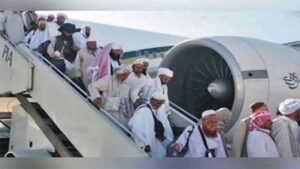
 ISLAMABAD/RIYADH -UNS :Pakistan’s preparations for this year’s Hajj have been thrown into serious uncertainty after nearly 67,000 prospective pilgrims were reportedly left without confirmed applications, following the closure of Saudi Arabia’s online visa-processing system before their cases could be completed.
Pakistan has been allocated a total Hajj quota of 179,210 pilgrims, divided equally between the government and private sectors. The Hajj Organisers Association of Pakistan (HOAP) says only around 23,000 private-sector applications have been confirmed, while approximately 67,000 remain unconfirmed, with about 13,000 applicants reportedly excluded from the Saudi system.
The development has triggered an urgent appeal for government intervention. HOAP has called on President Asif Ali Zardari, Prime Minister Shehbaz Sharif and the Chief of Army Staff to engage with the Saudi authorities and seek an emergency 72-hour extension to enable the affected pilgrims to complete the visa process.
Speaking at a press conference at the Karachi Press Club, HOAP Media Coordinator Muhammad Saeed said the crisis was largely linked to the earlier-than-expected closure of the Saudi Nusuk digital platform. He said the platform closed roughly a month earlier than in previous years, leaving a substantial number of applications pending.
The dispute has been compounded by a significant difference between Pakistan’s domestic Hajj application timetable and the Saudi processing deadline.
HOAP Chairman Zaeem Akhtar Siddiqui said the Government of Pakistan announced its Hajj policy on 27 November 2024, after which the Ministry of Religious Affairs began accepting applications under the government scheme from 28 November until 25 March in several phases.
The private sector was formally authorised to begin accepting Hajj applications on 14 January, while partial approvals for private Hajj packages had been issued on 8 January. Following the removal of deficiencies, the packages were finalised by 18 March.
However, the Saudi online system had closed on 21 February, creating a serious administrative gap and leaving thousands of applicants unable to complete the process.
HOAP has urged Islamabad to seek an exceptional extension from Riyadh, warning that without urgent intervention, thousands of Pakistanis could be prevented from undertaking Hajj despite having initiated the application process.
Saudi Anti-Corruption Investigations Put Visa Facilitation Under Scrutiny
The visa crisis comes amid separate Saudi anti-corruption investigations involving alleged bribery, abuse of official authority and the unlawful facilitation of Hajj and Umrah visas.
Saudi Arabia’s Oversight and Anti-Corruption Authority (Nazaha) has referred a number of cases involving alleged corruption and abuse of office to the competent judicial authorities.
In one confirmed judicial case, a Riyadh court sentenced a former Saudi ambassador to six years in prison and a fine of SR300,000 after convicting him of bribery and abuse of official authority in connection with the unlawful facilitation of Hajj and Umrah visas in return for financial payments.
The case forms part of wider Saudi efforts to enforce anti-corruption laws and hold officials and other individuals accountable for exploiting public positions or official services for private financial benefit.
Separate Visa-Bribery Allegation Remains Unproven
Separately, a Saudi Arabic-language newspaper reported that Nazaha had received a complaint alleging that an ambassador was accepting €150, approximately SR774, in exchange for facilitating visa issuance through a private office.
The allegation remains subject to investigation and must not be presented as an established criminal offence.
Crucially, available reporting does not establish any connection between the separate allegation and Nawaf bin Saeed Al-Malki, Saudi Arabia’s Ambassador to Pakistan.
No allegation of bribery, abuse of authority or visa-related misconduct should therefore be attributed to Ambassador Al-Malki as fact unless supported by an official statement from the competent Saudi authorities, a judicial ruling or another authoritative source specifically identifying him.
The distinction is particularly important. The former ambassador’s case represents a confirmed judicial conviction, whereas the separate claim is an unverified allegation reportedly under investigation. Conflating the two could lead to the wrongful attribution of criminal conduct to an individual who has not been identified in the available official or judicial record.
Pakistan Expands Hajj Medical Deployment Amid Extreme Heat Risks
While the visa dispute has created uncertainty for thousands of prospective pilgrims, Pakistan has expanded its Hajj medical operation in Saudi Arabia, deploying hundreds of healthcare personnel and reinforcing medical facilities for Pakistani pilgrims.
Medical teams are operating around the clock across Makkah, Madinah and Jeddah, with the expanded system including dozens of dispensaries and a newly established hospital.
The enhanced medical deployment follows new Saudi health requirements under which dedicated medical facilities are to be provided for pilgrim groups of around 5,000 people.
The measures are intended to strengthen medical preparedness against the major health risks associated with Hajj, including extreme summer temperatures, heat exhaustion, overcrowding and communicable diseases.
With nearly 179,000 Pakistani pilgrims expected to participate, the scale of the operation represents a substantial logistical and medical commitment by Islamabad.
However, the unresolved visa-processing crisis remains the most immediate challenge confronting Pakistan’s Hajj arrangements. Unless an extension or other exceptional arrangement is secured, tens of thousands of prospective pilgrims could remain unable to complete their travel and visa formalities, placing their participation in this year’s pilgrimage in serious jeopardy.

