
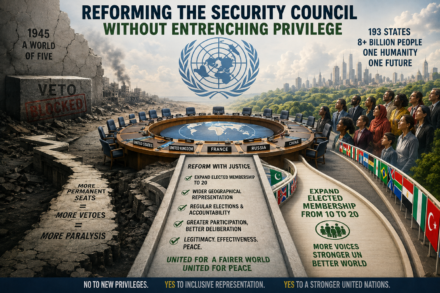

by Muhammad Mohsin Iqbal The United Nations was founded in 1945 after the League of Nations had failed to preserve peace. Its Security Council was designed for the world that emerged from the Second World War, with five permanent members holding the veto and a small number of elected seats. […]
Peace

by Muhammad Mohsin Iqbal President Donald John Trump occupies a singular place in the history of American leadership. He is at once a politician, a successful businessman, and an enthusiast of freestyle wrestling. His manner of thinking, planning, and decision-making bears a character distinctly different from that of his predecessors; […]
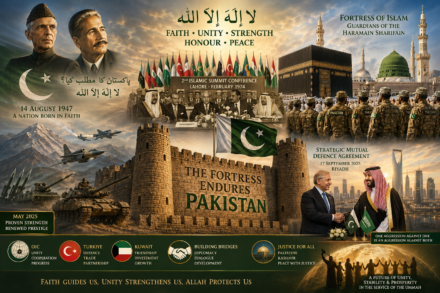
by Muhammad Mohsin Iqbal Pakistan stands as a living testament to an enduring spiritual and ideological conviction. From its very inception, the rallying cry that unified millions were both simple and profound: “What does Pakistan mean? La ilaha illallah.” Under this banner of faith in the Oneness of Allah, the […]
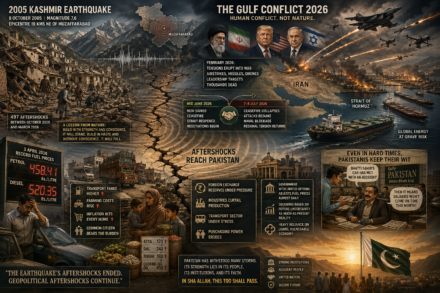
by Muhammad Mohsin Iqbal In the autumn of 2005, the earth rose in wrath against the ancient hills of Kashmir. On the eighth day of October, a violent convulsion of 7.6 magnitude tore through the region, its epicentre lying a mere 19 kms northeast of Muzaffarabad. The tremor was felt […]

by Muhammad Mohsin Iqbal In the shadowed epochs before the dawn of Islam, the affairs of mankind were beset by profound confusion and moral clutter. The pursuit of ethical values, the recognition of basic human rights, the establishment of social equality, and the fair administration of justice remained fragmented ideals, […]

by Muhammad Mohsin Iqbal The history of Iranian civilisation unfolds as one of the grandest tapestries in the story of mankind, spanning more than two thousand five hundred years of recorded glory and endurance. From the sunlit heights of the Achaemenid Empire, founded by Cyrus the Great in 550 BCE, […]
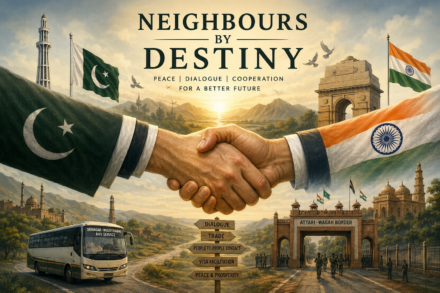
by Muhammad Mohsin Iqbal In the teachings of Islam, the bonds of human society are held in the highest regard, alongside the duties of worship. The rights of neighbours, in particular, have been emphasised time and again in the Holy Quran and the traditions of the Prophet Muhammad, peace be […]

Pakistan: The Candle of Peace explores Pakistan’s emergence as a trusted mediator in one of the most sensitive geopolitical crises of recent times. Through diplomacy, courage, and statesmanship, Pakistan helped bridge differences between the United States and Iran, averting a conflict that threatened regional stability and the global economy. The article argues that Pakistan’s role as a peacemaker has not only enhanced its international standing but also opened new avenues for regional prosperity, Muslim unity, energy cooperation, and economic development. It presents Pakistan as a nation that chose dialogue over discord and, in doing so, lit a candle of peace whose glow may illuminate the region for years to come.

True influence is not always measured by visibility. Sometimes it is found in the football crafted in Sialkot before it reaches a World Cup stadium, and sometimes in the quiet diplomacy that helps prevent conflict before it reaches the battlefield. In both arenas, Pakistan’s contribution deserves recognition.