

By Qamar Bashir
Press Secretary to the President (Rtd)
Former Press Minister, Embassy of Pakistan to France
Former Press Attaché to Malaysia
Former MD, SRBC | Michigan, USA
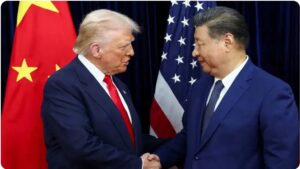
The proposed meeting of Presidents Xi Jinping, Vladimir Putin and Donald Trump in China could become a defining moment in shaping the international order for decades. The publicly declared agenda may revolve around global peace, nuclear security, trade, economic cooperation and strategic stability. Beneath these diplomatic priorities, however, lie competing geopolitical ambitions, concealed strategic calculations and opportunities to resolve two devastating wars that have inflicted enormous economic suffering upon the world.
The three leaders approach the negotiating table with vastly different political circumstances. Trump faces the fallout of the midterm elections, the unresolved confrontation with Iran and strained relationships with traditional allies in Europe, Canada and the Middle East. Putin remains deeply embroiled in Ukraine, where prolonged warfare continues to consume Russia’s military, economic and human resources. Xi Jinping, by contrast, faces no comparable military entanglement and commands an expanding network of international economic partnerships.
Each president nevertheless possesses extraordinary geopolitical leverage. The United States remains the world’s largest economy, a dominant consumer market and a formidable military and technological power. Its leadership in artificial intelligence, financial markets and innovation gives Washington enormous international influence. A single presidential statement can shake stock exchanges, influence energy prices and alter diplomatic calculations across continents. American economic sanctions, military capabilities and financial institutions remain powerful instruments of international pressure.
Russia’s strength rests upon its nuclear arsenal, vast territory and immense reserves of oil, natural gas, minerals and other strategic resources. Yet its continuing involvement in Ukraine has restricted its diplomatic flexibility, strained its economy and complicated its relationships with Europe. Ukrainian strikes deep inside Russian territory further demonstrate the mounting costs of prolonged confrontation. Moscow therefore has powerful incentives to seek a settlement that protects its security interests while ending an increasingly expensive conflict.
China possesses a different and potentially more consequential form of leverage. As the manufacturing powerhouse of the world, it commands industrial production, global supply chains, rare-earth processing and permanent magnet manufacturing. Its Belt and Road Initiative connects more than 140 participating countries through infrastructure, trade and investment. Expanding maritime networks, alternative transport corridors, digital connectivity and international financial arrangements further strengthen Beijing’s influence.
China’s growing use of the renminbi in international settlements also represents a long-term challenge to the dollar-dominated financial system. Although the dollar remains the principal global reserve currency, Beijing is steadily developing alternatives that could reduce dependence upon American financial institutions. China’s industrial strength and supply-chain influence provide Xi with considerable negotiating leverage, even without matching America’s worldwide military reach or Russia’s natural-resource abundance.
These contrasting strengths create three distinct negotiating agendas. Trump may seek recognition of American military success against Iran and demand that China and Russia reduce their economic, diplomatic and strategic support for Tehran. Xi may insist that China’s relations with Iran are sovereign bilateral matters beyond Washington’s authority. Putin, meanwhile, may seek American and Chinese recognition of Russia’s security concerns and negotiating position in Ukraine, including concessions that European governments might strongly oppose.
The political atmosphere surrounding such negotiations could also be influenced by intelligence controversies. Allegations involving Nvidia’s Jensen Huang and an alleged Chinese honey-trap operation have generated competing narratives about espionage and political manipulation. The historical use of sexual entrapment and blackmail by intelligence services associated with Britain, the United States, Russia and Israel raises questions about attempts to attribute similar practices to Beijing. If accusations against China are unfounded, their exploitation for diplomatic advantage could backfire against Washington.
Yet beyond these rivalries lies a far greater opportunity. The Ukraine and Iran conflicts have consumed enormous resources, disrupted international trade, threatened energy security and diverted national wealth from development toward destruction. Their consequences reach households, industries and governments far removed from the battlefields. The three presidents possess sufficient collective influence to explore settlements addressing the underlying disputes rather than merely managing their military consequences.
In Ukraine, the central diplomatic bargain could involve denying NATO membership in exchange for Russia’s complete withdrawal from occupied Ukrainian territory. Moscow would receive negotiated security assurances, while Kyiv would recover its internationally recognized borders, independence and territorial integrity. International guarantees, monitoring arrangements and phased sanctions relief could reinforce implementation. Such a settlement would require Ukraine’s agreement and credible protection against renewed aggression.
For Russia, peace would release enormous resources currently consumed by warfare and open possibilities for economic recovery. Ukraine could begin reconstruction, restore productive capacity and facilitate the return of displaced citizens. Europe could reduce the economic burden of confrontation, restore commercial confidence and redirect resources toward industrial development, infrastructure and public welfare. A negotiated security arrangement could replace a destructive military stalemate with a framework for long-term regional stability.
The Middle Eastern conflict demands an equally fundamental political settlement. The unresolved Palestinian question remains a central source of regional hostility. A genuine two-state solution establishing an independent, sovereign and viable Palestine alongside Israel could transform the strategic environment. Palestinian independence, recognized borders and security guarantees for both states could create conditions for reconciliation that decades of military confrontation have failed to achieve.
For Iran, Palestinian liberation has remained a principal declared objective of its regional policy. Establishing a sovereign Palestinian state could satisfy that objective and substantially diminish one of the political foundations of confrontation with Israel and the United States. Washington would then have an opportunity to replace military intervention with diplomacy, while Israel could pursue lasting security through political accommodation rather than recurring warfare.
Ending both conflicts would also serve China’s fundamental economic interests. Secure maritime routes, uninterrupted energy supplies, predictable commodity prices and stable international commerce are indispensable to its manufacturing economy. Reduced threats to the Strait of Hormuz and other strategic waterways could lower shipping risks, stabilize markets and restore confidence throughout global supply chains. Russia and the United States would likewise benefit from reduced military expenditures and expanding economic opportunities.
The decisive question is whether the three leaders will use their immense leverage to extract unilateral concessions or construct mutually acceptable settlements. Washington could encourage Israeli acceptance of Palestinian statehood, Moscow could accept Ukraine’s territorial restoration, and Beijing could facilitate diplomatic guarantees, reconstruction and economic cooperation. Their collective influence could help transform two costly conflicts into opportunities for international reconciliation.
Xi Jinping’s vision that the planet is large enough for all nations to develop and prosper together offers a framework for such cooperation. Rather than pursuing supremacy through military confrontation, economic coercion and strategic rivalry, the three powers could demonstrate that their competing strengths can contribute to collective security and prosperity.
If wisdom prevails, the Xi–Putin–Trump summit could achieve far more than diplomatic declarations. It could initiate two historic settlements, remove major sources of international instability and establish the foundations of an emerging world order in which peace replaces confrontation, cooperation replaces coercion, and shared prosperity triumphs over destructive geopolitical rivalry.

