LAHORE -UNS : Interior Minister Mohsin Naqvi met Pakistan Muslim League-Q (PML-Q) President Chaudhry Shujaat Hussain on Monday to discuss the country’s political and administrative situation, law and order, and measures being taken by the government.
During the meeting at Chaudhry Shujaat’s residence, the two leaders exchanged views on the devolution of powers to the grassroots level and the proposal for creating new provinces
Chaudhry Shujaat Hussain said the establishment of new provinces was directly linked to public convenience, improved governance and administrative efficiency. He stressed that strengthening administrative units and empowering them could help address public issues more effectively.
He said ordinary citizens were the country’s most important stakeholders and that decisions concerning the future of Pakistan should reflect their needs and aspirations.
Chaudhry Shujaat emphasised that timely and appropriate decisions were essential for the country’s progress, warning that leaders would be held accountable if they failed to take necessary steps in the national interest.
The PML-Q president said administrative reforms, including the creation of new provinces, should be considered in the broader context of improving service delivery, ensuring better governance and facilitating people at the local level.
Interior Minister Mohsin Naqvi also underscored the importance of making decisions in accordance with the aspirations of the people, saying public interests should remain the foremost priority.
The meeting comes amid renewed national debate over administrative restructuring, the creation of new provinces and the need to strengthen local governance mechanisms in Pakistan.
Both leaders discussed the importance of effective governance and empowering administrative structures to ensure that government policies and services reach citizens more efficiently.
Mon Nov 23 , 2026
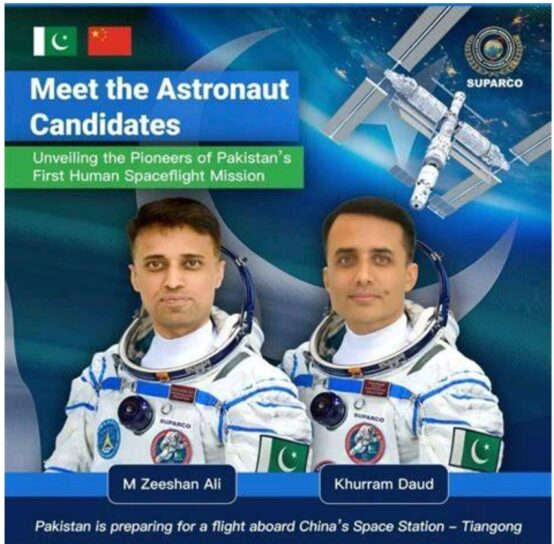
By SM Hali Pakistan’s first astronaut mission aboard China’s Tiangong Space Station fulfils a dream cherished by generations and opens a new frontier for the nation’s youth. For my generation, space exploration was not merely science. It was magic. It was the ultimate frontier that ignited dreams, fuelled imaginations, and convinced young minds that the impossible could indeed become possible. As a child, I was fascinated by the exploits of the early pioneers of space. I carefully preserved newspaper clippings of Yuri Gagarin’s historic voyage aboard Vostok-1 in April 1961, when he became the first human to journey into space. Those yellowing clippings remain among my treasured possessions to this day. Equally precious are the newspaper cuttings documenting mankind’s greatest adventure, the July 1969 Moon landing by Neil Armstrong and Buzz Aldrin. For a young boy growing up thousands of miles away from Cape Canaveral, Baikonur, or Houston, these stories opened windows to the cosmos. The fascination never faded. When I visited Moscow in 2017, I made it a point to visit the renowned Museum of Cosmonautics. Standing before the towering statue of Yuri Gagarin was an emotional experience. Here stood the man whose achievement had inspired generations across the globe. The museum’s exhibits brought to life the courage, determination, and ingenuity that made human spaceflight possible. My fascination was further enriched by stories from the Soviet space programme. One tale that particularly captivated me as a child was that of Laika, the pioneering canine launched aboard Sputnik-2. Whether embellished through retelling or coloured by childhood imagination, it became part of family lore, a story I still narrate to my grandchildren as a reminder of humanity’s relentless quest to push beyond known boundaries. Similarly, visits to the Smithsonian Institution’s National Air and Space Museum in Washington, D.C., allowed me to marvel at the artefacts of the Apollo programme and appreciate the enormity of Neil Armstrong’s giant leap for mankind. Those journeys reaffirmed my lifelong admiration for the pioneers who dared venture where none had gone before. Today, as Pakistan prepares to send its first astronaut to China’s Tiangong Space Station, I find myself reliving that same sense of wonder I experienced as a child. In April, two outstanding Pakistani military aviators, Muhammad Zeeshan Ali and Khurram Daud, were selected for astronaut training in China. One hails from the Pakistan Air Force and the other from the Pakistan Navy. They underwent rigorous preparation at the China Astronaut Research and Training Centre in Beijing. Following extensive training, one of them will be selected to board the Shenzhou-24 mission, spend approximately a week aboard the Tiangong Space Station, and return safely to Earth. This landmark endeavour stems from the historic cooperation agreement signed between SUPARCO and the China Manned Space Agency in February 2025, opening an entirely new chapter in Pakistan’s scientific and technological journey. This is not merely an individual accomplishment. It is a defining moment in Pakistan’s national history. For decades, human spaceflight was the exclusive domain of the United States and Russia. America’s Apollo missions carried humans to the Moon, while the Soviet Union achieved many of the earliest milestones of the Space Age. Today, China has emerged as a third major space power. Through strategic vision, consistent investment, and technological excellence, it has built its own space station, landed probes on the Moon and Mars, and established itself as a leader in space exploration. The Tiangong Space Station symbolises China’s arrival as a major force in the cosmos. Pakistan’s participation demonstrates not only China’s willingness to share the benefits of scientific progress with friendly nations but also the extraordinary depth of Sino-Pak relations. The friendship that has long been described as higher than the Himalayas, deeper than the oceans, and sweeter than honey has now extended beyond the confines of Earth itself. For Pakistan, the implications are profound. The mission promises to inspire a new generation of scientists, engineers, researchers, and innovators. Young Pakistanis watching one of their own orbit the Earth will realise that careers in science, technology, engineering, mathematics, artificial intelligence, robotics, and aerospace are not distant dreams but attainable ambitions. Participation in human spaceflight opens doors to advanced research, scientific experimentation, aerospace medicine, satellite technology, and a host of frontier sciences that will shape the future. On a personal level, this achievement carries special significance. Like many dreamers of my generation, I too harboured aspirations of travelling into space. As an Air Force officer, my ambitions allowed me to conquer the skies, yet outer space remained beyond my reach. That dream belonged to an era when such opportunities seemed unimaginable for Pakistanis. Yet dreams possess remarkable endurance. They transcend generations, patiently awaiting their moment. While I may never gaze upon Earth from the cupola of a space station, younger Pakistanis now stand poised to achieve what my generation could only dream about. In many ways, their journey fulfils our dreams as well. When a Pakistani astronaut looks down upon the blue planet from Tiangong, he will not merely represent himself. He will represent every Pakistani child who has ever looked up at the night sky and wondered what lies beyond the stars. He will carry with him the hopes of 250 million people, the promise of scientific excellence, and the conviction that no frontier is beyond the reach of human determination. But this mission is about far more than sending one Pakistani into space. Its true significance lies in the millions of young minds it will inspire on Earth. Somewhere in a classroom in Gilgit, Gwadar, Karachi, Lahore, Peshawar, Quetta, or Islamabad sits a child who will watch this historic voyage and dare to dream bigger than ever before. One may become an astronaut; another may design spacecraft, develop artificial intelligence, pioneer space medicine, or lead Pakistan’s future lunar and planetary missions. Nations rise not merely through their resources but through the power of their dreams. This mission signals that Pakistan is ready to embrace the future, invest in knowledge, and compete in the frontiers of science and technology. For our youth, the message could not be clearer: the sky is no longer the limit. For the first time in our history, the pathway from a Pakistani classroom to outer space is no longer a fantasy. It is a reality. And that may prove to be the most extraordinary achievement of all.