


By Iftikhar Mashwani
Pakistan’s persistently high interest rates, rising energy costs, increasing petroleum levies and higher corporate taxation are placing mounting pressure on the country’s industrial sector, raising serious questions about the future of exports and sustainable economic growth.
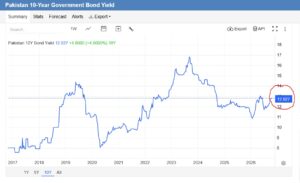
The 10-year government bond yield highlights the challenge facing Pakistan compared with regional competitors. According to the figures shown in the charts, Pakistan’s 10-year government bond yield stands at 12.83 per cent, compared with 8.54 per cent in Bangladesh and 7.47 per cent in India.
This significant gap reflects the higher cost of borrowing faced by businesses in Pakistan, making financing for industrial expansion, modernisation and working capital considerably more expensive.
Interest expenses, however, are only one component of the growing cost of production. Rising energy prices, petroleum levies that increase transportation costs, and a tax environment perceived by businesses as increasingly burdensome further weaken the competitiveness of domestic manufacturers.
How Can Pakistani Industry Compete?
When local manufacturers face higher financing and operating costs than their regional competitors, they struggle to offer internationally competitive prices.
Exporters must compete on quality, efficiency and delivery while managing expenses that can erode their profit margins and limit their ability to invest in new technology.
The consequences extend beyond individual businesses. Reduced industrial investment, declining export competitiveness and pressure on production can constrain employment opportunities, foreign exchange earnings and overall economic growth.
A Need for a Competitive Economic Framework
Pakistan needs a coordinated economic strategy that addresses the cost of doing business. Sustainable reductions in inflation and borrowing costs, reliable and competitively priced energy, rationalisation of transportation-related levies, and a predictable and fair tax system could help restore business confidence.
Policies that encourage productivity, investment, technological upgrades and export diversification are equally important. Improving access to affordable financing and reducing unnecessary regulatory costs would also help manufacturers compete in international markets.
Can Pakistan Achieve Sustainable Growth Without Competitive Industry?
The fundamental question is whether Pakistan can achieve sustained economic growth while its industries face significantly higher financing costs than competing economies.
How can domestic manufacturers expand production, attract investment and increase exports when the cost of borrowing and doing business remains so high?
Economic growth cannot be sustained through stabilisation measures alone. It requires a productive, competitive and export-oriented industrial base capable of creating jobs, earning foreign exchange and attracting long-term investment.
Pakistan must therefore reconsider its economic priorities and create conditions in which businesses can produce competitively, invest confidently and succeed in global markets.

