 By Zahid Nasim Khattak
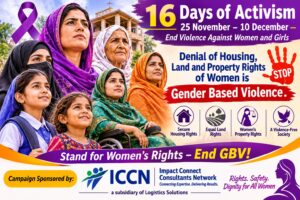
As the world observes the 16 Days of Activism Against Gender-Based Violence (25 November 10 December), we must confront an overlooked form of violence against women: denial of their housing, land and property (HLP) rights. Inheritance denial, land grabbing, forced relinquishment and unlawful eviction are forms of economic dispossession that remain insufficiently recognised as gender-based violence (GBV).
A woman deprived of her rightful property loses more than an economic asset; she loses security, independence, dignity and control over her life.
In Pakistan, such deprivation often occurs within families. Male relatives use intimidation, emotional blackmail and coercion to deny women their inheritance. In the name of family unity and tradition, women are pressured into surrendering their rightful shares, sometimes without free and informed consent.
The statistics reveal a stark disparity. The World Bank’s 2024 report, Women’s Economic Empowerment in Pakistan, estimates that only 3% of women own homes, compared with 72% of men; landownership stands at 2% for women against 27% for men. UN Women-supported research indicates that 97% of women in the surveyed population did not inherit land or a house.
Pakistan’s Constitution guarantees property rights and equality under Articles 23, 24 and 25. Section 498A of the Pakistan Penal Code criminalises illegal deprivation of women’s inheritance, while the Enforcement of Women’s Property Rights Act 2020 provides redress in Islamabad Capital Territory. Yet laws alone cannot dismantle entrenched patriarchal practices.
Property deprivation can become an instrument of domestic violence and control. Women claiming inheritance may face threats, abandonment, eviction or physical assault. Without independent assets or secure housing, escaping abusive relationships becomes extremely difficult. A 2022 study involving 16 women deprived of inherited land and 11 legal experts identified male dominance, forced gifting, fear of violence and family pressure as key drivers of dispossession.
The connection between inheritance disputes, patriarchal control and so-called honour killings also demands attention. Research published in the European Journal of Public Health documented 1,957 honour-killing events in Pakistan between 2004 and 2007. Another study examining media-reported cases from 2015 ,2022 documented 8,312 cases across four provinces. Although not every case is property-related, inheritance disputes and economic interests must never be concealed behind claims of honour.
Widows, divorced or abandoned women, women headed households and women with disabilities are particularly vulnerable. The 2022 floods, affecting over 33 million people, further exposed how insecure tenure and missing ownership documents can exclude women from compensation and reconstruction assistance.
UN Habitat Pakistan highlighted the intersection of women’s HLP rights and GBV through a national conference during the 2023 16 Days of Activism, followed by nationwide stakeholder training. UN Women, the World Bank and the National Commission on the Status of Women have also contributed through research and advocacy. These efforts must translate into effective law enforcement, transparent land records, affordable legal assistance and accountability. ICCN (Impact Connect Consultants Network) also promotes awareness, advocacy and collective action for gender equality and women’s rights.
As we mark the 16 Days of Activism, let us recognise that GBV does not begin and end with physical assault. It also begins when a daughter is denied inheritance, a widow dispossessed of her home, or a woman threatened for claiming her rightful land.
A woman’s inheritance is not a favour from her father, brother or husband. It is her legal right. No family tradition or claim of honour can justify its denial.
Denying women their housing, land and property rights is gender based violence. Protecting these rights means protecting women’s lives, dignity, independence and future.