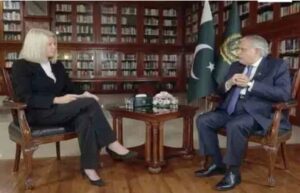
 ISLAMABAD-UNS : Deputy Prime Minister and Foreign Minister Mohammad Ishaq Dar has called for strengthening the multilateral international system, rejecting bloc politics and unilateral actions, while stressing Pakistan’s commitment to maintaining balanced relations with major global powers, including the United States and China.
In an interview with Euronews, Dar said Pakistan believes in diplomacy, respect for sovereignty, territorial integrity and equality among nations, emphasizing that Islamabad could strengthen ties with Washington and Beijing simultaneously without compromising either partnership.
Discussing the US-Iran conflict, the foreign minister expressed hope for an early resolution and said Pakistan continued diplomatic efforts to facilitate dialogue and reduce regional tensions. He said Islamabad condemned Israel’s attack on Iran at the outset of the conflict while urging Tehran to exercise restraint and avoid targeting countries in the Middle East and Gulf region.
Dar said Pakistan participated in direct negotiations between the United States and Iran held on April 10 and 11, which lasted approximately 21 hours. Although progress was achieved on several issues, the talks remained inconclusive due to differences in priorities and positions.
He said Pakistan continued diplomatic engagement after the negotiations, contributing to efforts surrounding an Islamabad memorandum of understanding. Dar also highlighted a five-point peace initiative developed in cooperation with China and consultations involving Saudi Arabia and European countries, including Britain, France and Germany.
The foreign minister warned that the conflict had disrupted energy supplies and increased prices globally, affecting Pakistan’s economy and households. He said the government was providing targeted subsidies to low-income groups to mitigate the impact of rising petroleum and energy costs.
Dar called for developing a regional security framework to ensure sustainable peace and stability, while advocating reforms in international institutions, including the United Nations, World Bank and IMF.
Highlighting economic diplomacy, he cited Pakistan’s mineral potential, estimated at around $130 billion, and rare-mineral opportunities potentially worth $6 trillion to $10 trillion, stressing policy continuity and investment as keys to economic sustainability.